
Journal Your Way Out of a Mess

Image by Keith Chapman.

Image by Keith Chapman.

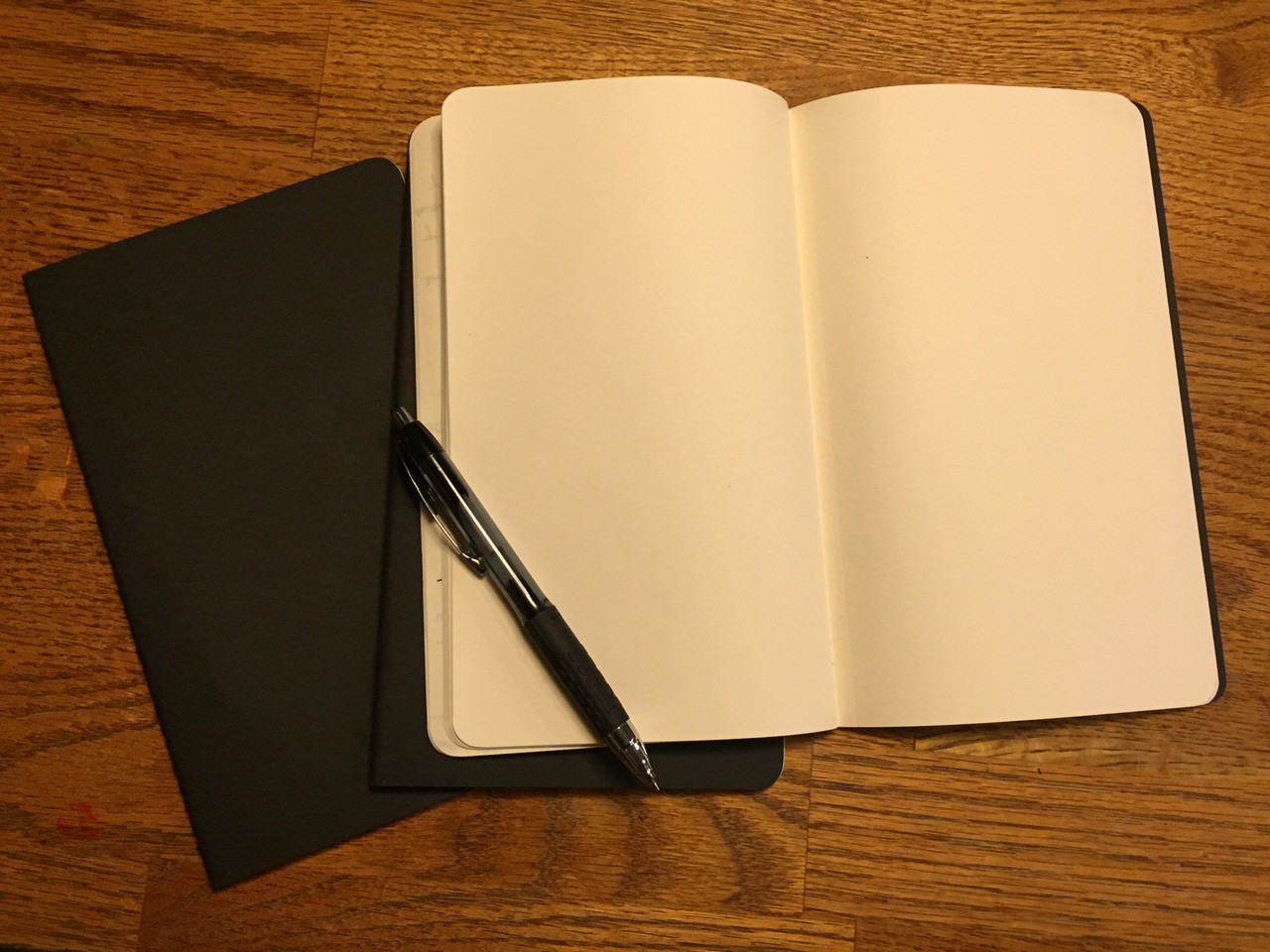
Word of advice: If you do anything creative (and that should be everyone) be sure to stock up on journals. A journal can be a nice Moleskine, a Baron Fig, a composition book, a giant sketch book, a stack of scrap papers stapled together, within an app on your phone, Evernote, or a pile of multi-colored Post-it notes. It really doesn’t matter. In fact, I use several of the above simultaneously, usually for different purposes.

If you are having a creative block, a nasty problem in front of you to solve, or feeling invincibly creative, you will benefit greatly by logging ideas (even the prematurely self-judged bad ones), complaints, problems, solutions, research, doodles, and random facts, quotes and general goofiness. Even if it seems absurd, stupid, ridiculous, impossible, or embarrassing write it down anyway. If nothing else you will make room for better ideas by purging the “bad ones” onto paper.

I really recommend a bound paper journal with a nice, easy writing pen that feels good in your hand, writes smoothly, and encourages you to keep using it. I use journals at my job and have for decades as an engineer and designer. Looking back, I’ve had some crazy ideas but some have turned into products and popular products at that. Seeing the incubation of ideas on paper turned eventually to product is one of the most satisfying things I’ve experienced. I recently took to journals for my hobbies, side projects and art as well. It has made those hobbies and art much more fulfilling. In fact, I wrote my first novel, Sushi Wars: A New Roll, entirely in Evernote because it kept distractions to a minimum and I was able to create notes immediately from my web research and story issues.

The benefits of writing journals are numerous but there are, admittedly, a few challenges that creep up. There is the dreaded false start. You buy a nice journal or you simply get a pad of paper and… fail to start writing in it. It sits there staring at you pristine, unopened, clean, blank, and perfectly smug. Do yourself a favor and bust through the seal and dirty that first page immediately. Write anything. It doesn’t matter. Just dirty it.

Another challenge seems to be continuity. You dirty that first page (and maybe that was easy for you) and you’re writing in it for a few days, maybe even a few days in a row and then life creeps in and you skip a day or two or twenty. Now you have a well-intentioned journal with only 3 dirtied pages. Pick up where you left off even if the entry is “I have no idea where I left off.” and go forward.

I use journals for product design complete with bad sketches and barely legible writings all in pen. I list research topics I want to get to and benign to-dos and action items from meetings, the more utilitarian side of journals. Where my journals really shine though is in solving seemingly unsolvable problems or combating dead ends (i-dea-d ends?!?!) and fighting through the monotony of the same old ideas rising to front of mind. I sometime doodle to music to free things up. Let your mind wander with pen in hand and you will quickly stumble onto ideas so good that you won’t understand how they actually got embedded in you in the first place.

My process includes writing about the problem or goal first and scoping out the issues completely either by drawings or words or a combination of media. Then, I typically doodle in the margins around the issue using symbols or pictures associated with the problem or goal. I find this drives the issue into a deeper level of understanding and likely stirs some subconscious fires and redirects thoughts and energy at the issue. Then I start listing actions I can take to step towards the goal or solution even if ever so slightly. It may simply start with “I have no ideas. I’ll have to research the term _____ on google just to get started.” I will keep listing actions I can take until I run way deep into crazy land and keep going until I’ve exhausted the crazy in me. Next, I look at the list and the doodles and I pick the best of them, even if they set camp up firmly in crazy land. I refine those few select ideas and concepts and iterate on them. I equate this process much like sanding a piece of wood. Take the rough edges away a little at a time and eventually you will get a shape that starts making sense. I keep repeating this process until I land on a fully actionable idea that is doable, makes sense, and strikes me as novel, innovative, or, at the very least, mildly impressive. If I haven’t been able to get there yet, I keep sanding. Some ideas take weeks, months, even years because i shelved them. But here is the important thing. I shelved them in a journal that can be picked up later, years later, and revisited. Then I find myself in a different place with new experiences and can quite possibly find a solution, iteration, or creative element from the original problem or goal that I can use.

Just keep writing, sketching, doodling in many, many journals with your ideas, concepts, and get your crazy on paper. Go nonlinear, go stupid, go without rules and see what happens. You’ll feel quite creative and hopefully feel much happier. I always do.

Now go. Create.  ~ The Mission Creative

Brainstorm like a Boss, not like your boss

Image by Rebecca Bloom Photography. http://www.bloomphoto.com

Image by Rebecca Bloom Photography. http://www.bloomphoto.com

How many times have you been told “we’ll have to brainstorm some ideas” or you are invited to a “brainstorm session” and first rolled your eyes, maybe actually suspended disbelief, and attended only to realize the brainstorm was really a meeting to listen to the boss’ ideas? Smile, nod, accept… move on. <sigh>

Or… perhaps you are in a healthier environment that is open to ideas and your organization can actually perform a brainstorm session that results in some new ideas. Is the quality of those ideas enough to engage resources on right away? Do you have a plan that will result in a creative or innovative result? Often not.

Here are some basic tenets and ideas on how to run an effective brainstorm session based on my years of design and research and development experience. This has worked well in my experience.

1. Keep the group small. A group under 6 people is ideal. Avoid closed minded people, distant stakeholders, and pessimistic people. If they want to attend they need to change some attitudes or get involved in more detail. Refuse to design by committee. It doesn’t work. Polarize! It is ok to have lovers and haters. Both will talk about your project.

2. Know what the goal is. Too many brainstorms have no goal, deliverable, or target in mind. The facilitators try to keep it “open ended” which translates to “delays” in the business world. Have a definitive goal defined at the start, like “We need to design a product that cuts the lawn shorter with little to no effort that is easy to clean and control.” Built into this statement is a goal with clear criteria outlined in an open enough way to provide leeway of new ideas. It doesn’t say a lawnmower but a product that cuts the lawn shorter – a subtle but important differentiation. If I say we need a lawnmower, you get an image in your head that is very much like what is out there already. However, if I say we need a product that cuts the lawn shorter, this opens the thinking process and may inherently question the norm because as long as the criteria of the lawn being shorter is obtained, the idea can be considered at this stage.

3. Actually facilitate with rules. Start the meeting with ground rules clearly explained to the group and hold them and yourself accountable to those rules. Suggestions include: Do not talk over one another. Do not criticize, challenge, judge, or nay-say any ideas until the idea creation time is completely exhausted. Know the difference between a complete idea and a component idea – both are welcomed. List and record all ideas. Ensure everyone on the team has multiple chances to talk and present ideas. Set a time limit for the session and stick to it.

4. Review all ideas and compare to all criteria. Identify the top 3 to 10 ideas that meet or come close to meeting the criteria of the goal or target regardless of how extreme it may seem at this stage. Revisit the criteria and consider modification of the criteria to improve results. Finally, compare final ideas to final criteria and determine which ideas are worth pursuing.

5. Create an action plan off of the results. Narrow the ideas down to the top 3 that satisfy or come closest to satisfying the final criteria. Create a plan to go execute each of the 3 ideas if they seem feasible to try. Otherwise, refine by having a secondary brainstorm session on each of the 3 main resulting ideas individually, refine the criteria of the goal with another layer of detail, and move closer to satisfying the criteria by brainstorming another level of detail on each of the main ideas.

6. Decide which idea is the best candidate to obtain the goal. The analysis might include cost estimates in resources, time, and money. It might include an evaluation of feasibility, availability, technology, and other component needs to accomplish the goal. One idea may be better than another in satisfying criteria but perhaps is too costly to develop. Compromises start at this level. The goals must prevail.

7. Make a decision. At the end of the brainstorm phase of a project, be sure to walk away with a clean decision, an action plan for the team with assignments, and buy-in from the creators. How creators feel about their creations often shape the outcome of the creations. In most cases, it is better to make a decision and pursue execution of the idea at this point than to sit in limbo with no clear direction. You can always change direction later or improve the project in a second phase or offering.

Now go. Create. ~ The Mission Creative

Creativity Jump Start in 3 Steps

Original Digital Art by Keith Chapman.

Original Digital Art by Keith Chapman.

When facing a blank page, a blank canvas or simply… a blank and you need to produce something… anything… at this point, try the following “simple” exercise. It’s like a shot of caffeine to the creative brain.

1. Think of an object that is for sale in a store that you shop at frequently. Write the first object you thought of down on a page of paper.

2. Think of an adjective that begins with the first letter of the object you wrote down. Take the very first one you thought of and write that adjective down on the same page as the object.

3. Below the object and adjective, write 10 connections between the adjective and the object without repeating notions. After a few, it should get crazy hard. That’s what you want. Persevere! By the 4th or 5th connection, you should be in crazy land but get 10 and you expanded beyond normal thought. Now… admire your oddities and hit that blank page, blank canvas, or that… blank… and create something spectacular.

As an example, here is one I just did:

Object: Tennis racquet, Adjective: tight

Connections:

1. The strings on my tennis racquet are tight.

2. My muscles are tight after using my tennis racquet.

3. The shot I made with my tennis racquet was tight up against the base line.

4. My grip on my tennis racquet was tight.

5. The grip tape was wrapped tight around the handle of my tennis racquet.

6. When I looked through my tennis racquet I framed the view of my opponent in a tight oval.

7. I rolled the handle of my tennis racquet in my shirt which made my shirt tight on my chest.

8. When I removed the strings from my tennis racquet, the frame was a tight fit over my head.

9. I strum my tennis racquet like a guitar because the strings seem as tight as guitar strings and the handle is like a guitar neck.

10. I bought a cheaper tennis racquet because money was tight.

Whew. That was not easy but that is the whole point. There will likely be obvious connections between the object and the adjective because your mind defaults to a connection to think of the adjective off of the initial object. However, after exhausting a few connections, you start looking for alternate meanings of words and alternate situations to put those words to use. I hope you find this exercise useful.

Now go. Create.  ~ The Mission Creative